If you have read a stroke rehabilitation report, you may have seen phrases like “upper limb Brunnstrom III” or “lower limb Brunnstrom V”. These are not academic decoration — the stage number decides which training your body is actually ready for.
What the Brunnstrom scale measures
After a stroke, recovery of movement tends to follow a predictable sequence. The Brunnstrom staging system describes six stages, from complete flaccidity (Stage I) to near-normal coordinated movement (Stage VI). It looks at spasticity, the return of voluntary movement and the emergence of movement patterns.
- Stage I — Flaccid: no voluntary movement, low muscle tone.
- Stage II — Early spasticity: basic synergy patterns appear, spasticity begins to develop.
- Stage III — Marked spasticity: synergies are voluntary but movement is still stereotyped.
- Stage IV — Declining spasticity: movement moves beyond pure synergy patterns.
- Stage V — Relative recovery: more complex, independent movements become possible.
- Stage VI — Isolated movement: coordination is close to normal, speed and precision still improving.
Why the stage matters so much
The same exercise can help one patient and hinder another, purely because of the stage they are in. In the flaccid stage, the priority is protecting the joint, preventing subluxation and stimulating activation — often with passive or assistive movement. Pushing for resisted strengthening too early can entrench abnormal synergy patterns.
By the spastic stage, training aims to lengthen tight muscle groups, break the synergy and reintroduce selective movement. In the late spastic stage, the emphasis shifts to strength, speed, endurance and task-specific practice for daily life.
How we match equipment to the stage
This is why our rehabilitation hall is organized around stage-matched systems rather than a single machine. Devices used in our programs explicitly support passive, assistive, active and resistive modes across Brunnstrom stages I–VI:
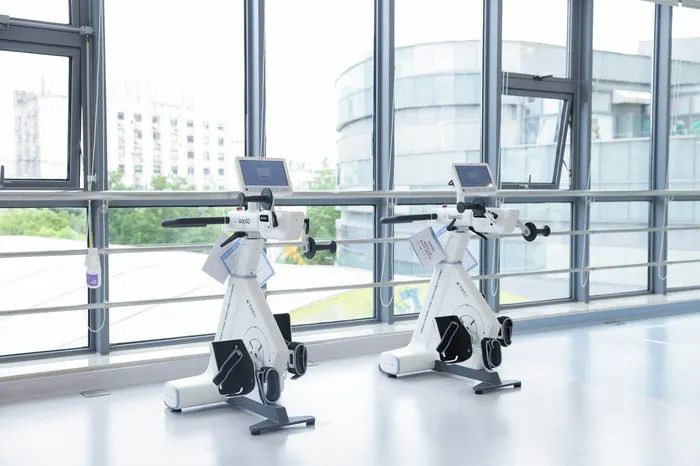
- Flaccid and early spastic stages: active-passive trainers (LoopGO Pro) and body-weight-supported stepping (ReBorn, overhead track) keep joints moving safely while the patient regains activation.
- Spastic stages: the ankle trainer (AnkPower) and 3D linear upper-limb systems (ArmLine) combine range-of-motion and strength assessment with six training protocols that adapt as the stage changes.
- Late spastic to recovery stages: eye-tracking guided systems (ArmGuider Pro), modular hand and wrist training (Dynaxis) and cognitive-motor occupational training (APTable Pro) target precision, coordination and daily living tasks.
Assessment is not a formality
At admission, every patient receives a baseline assessment covering range of motion, muscle strength, tone and functional ability, limb by limb. Each training cycle ends with re-assessment and a plan adjustment. That rhythm — assess → train → re-assess — is what turns a list of machines into an actual recovery curve.