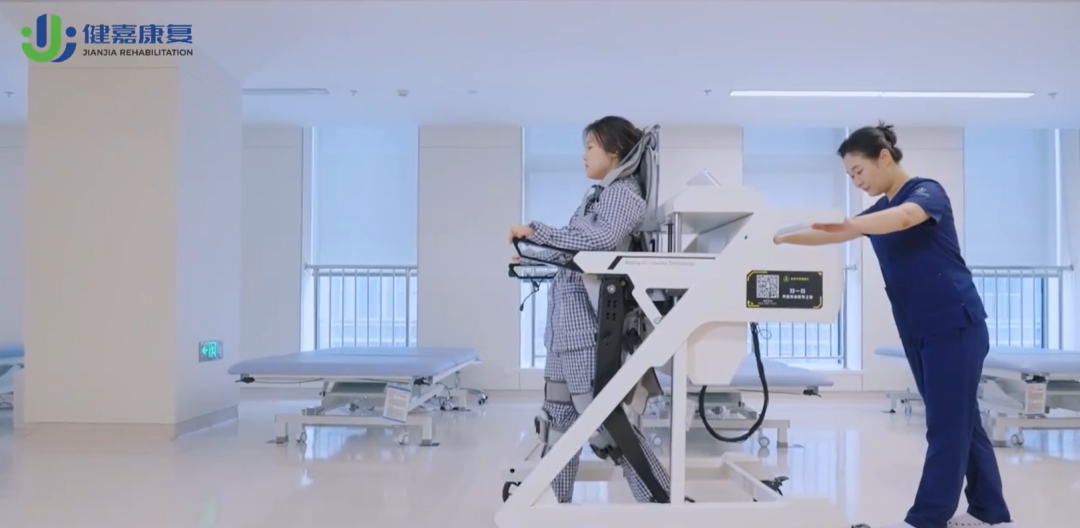
Strap into an exoskeleton robot, and — with a rehabilitation therapist guiding and guarding — you take one step, then another. Many patients and families ask the same two questions: "If I put it on, can I just walk?" and "After training for a while, will I be able to give up the device?"
For this instalment of the JianJia Rehabilitation Lower-Limb Month, we look at what an exoskeleton robot actually does, how it takes part in gait training, and why a professional assessment has to come before anyone puts one on.
How does an exoskeleton take part in gait training?
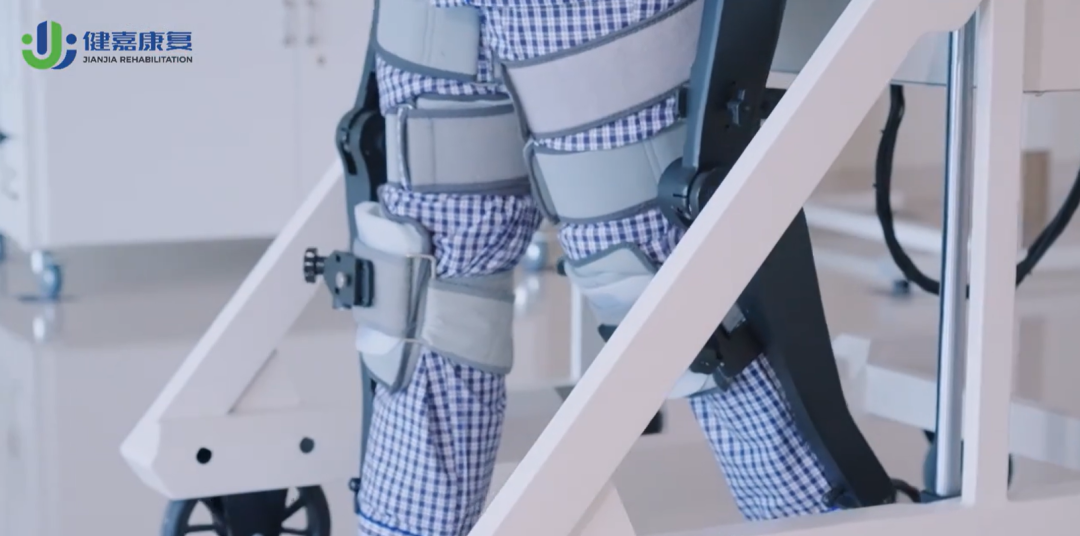
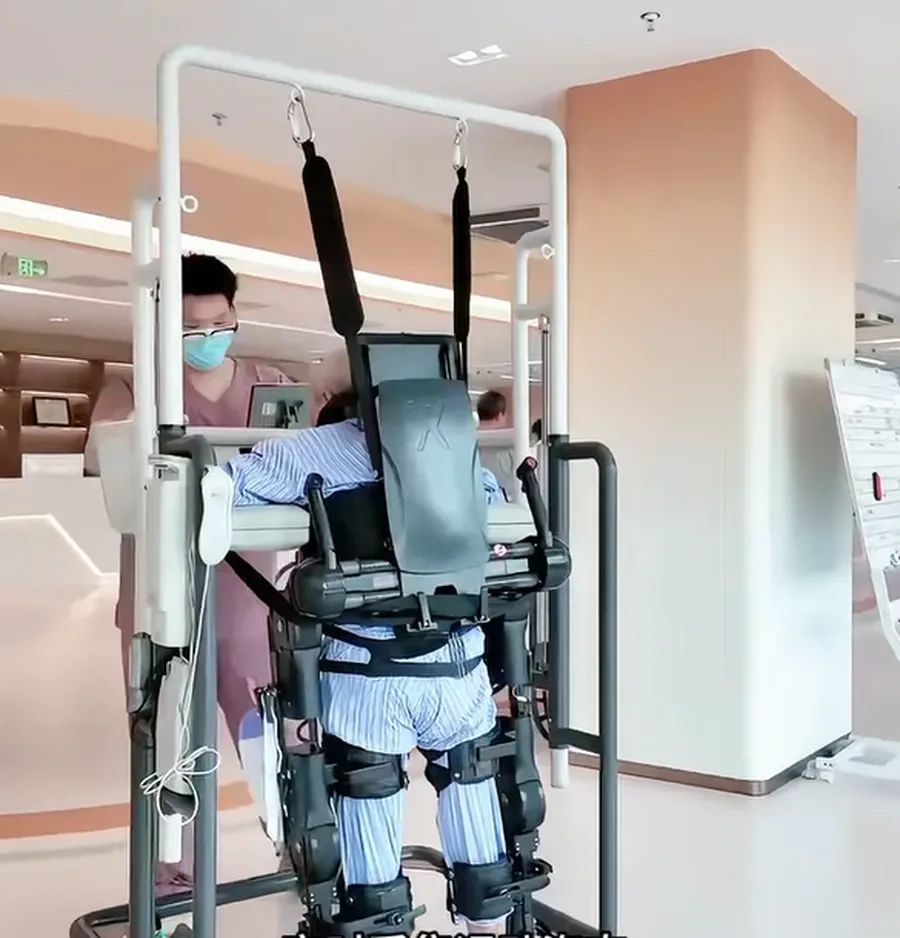
A powered lower-limb exoskeleton used in walking rehabilitation is best understood as a mechanical device worn on the outside of the body that supplies assistance to lower-limb movement. Devices differ in structure, drive system, how much assistance they give, and who they are suitable for.
During a session the device delivers assistance according to its settings and helps the patient complete a certain stepping motion. The therapist's role is to fit and adjust the device, configure the training, and keep observing the patient's physical responses and movement quality.
What is the difference between being moved and being able to walk?
Walking is not only about moving the legs. It also involves controlling the body's centre of mass, keeping balance, coordinating both lower limbs, and adjusting when you stop or change direction. When an exoskeleton provides a lot of assistance, a patient may complete movements that would otherwise be beyond them — but part of that capacity comes from the machine.
So the distance covered and the speed reached in a device cannot be read directly as walking ability without it. The rehabilitation team also has to assess which walking tasks the patient can complete with the device off, whether supervision or physical help is still needed, and whether a cane or walker is required.
| In the device | Without the device |
|---|---|
| More steps, further and faster, are possible | Step count and distance depend on the patient's own strength, balance and endurance |
| Balance is supported by the frame and harness | Balance must be kept independently or with a walking aid |
| The therapist sets how much assistance is given | The patient decides how much to initiate and how hard to push |
| A controlled environment for practice | The ability that actually counts in daily life |
One clarification: "independent walking" does not necessarily mean walking with no equipment at all. The functional walking categories used in the relevant research, for example, still allow a cane or a similar aid — what they focus on is whether the person still needs another person's supervision or physical help.
So when judging progress, look beyond step count and distance. Ask under what conditions the patient walked, and whether those abilities carry over into daily life.
Choosing a training mode is not just "passive early, active later"
How much assistance the device gives, and how much the patient has to contribute, should be set from a functional assessment and from the characteristics of the equipment. It cannot simply be divided into "passive in the early stage, active in the later stage".
Two people at a similar point in their illness can differ widely in muscle strength, balance, joint range of motion, and their ability to understand and cooperate with instructions. The programme has to be adjusted to what the patient actually does and how much their body can tolerate.
What can exoskeleton training actually help with?
A Cochrane systematic review updated in 2025 suggests that, for people after stroke, mechanised or robot-assisted gait training combined with physiotherapy may improve the chance of achieving independent walking by the end of training, compared with gait training that does not use this kind of equipment.
That said, the review covers many different training devices. It cannot be read as proof of efficacy for any single exoskeleton, and its conclusions from stroke patients cannot be extended directly to everyone with lower-limb impairment.
Back to life
Rehabilitation ultimately has to come back to daily life: can the patient stand up, transfer and walk more safely, and can they depend less on other people?
JianJia Rehabilitation's October Lower-Limb Month is about understanding rehabilitation technology and the goals behind each training session, so that every step of practice has a clearer direction.
This article is health education and does not replace individual medical advice. Video and photography show professional demonstrations; any training must be preceded by an assessment and carried out under professional supervision.
References: Mehrholz J, Kugler J, Pohl M, et al. Electromechanical-assisted training for walking after stroke. Cochrane Database of Systematic Reviews, 2025, 5(5): CD006185. Molteni F, Guanziroli E, Goffredo M, et al. Gait recovery with an overground powered exoskeleton: a randomized controlled trial on subacute stroke subjects. Brain Sciences, 2021, 11(1): 104. He Y, Eguren D, Luu T P, et al. Risk management and regulations for lower limb medical exoskeletons: a review. Medical Devices: Evidence and Research, 2017, 10: 89-107.