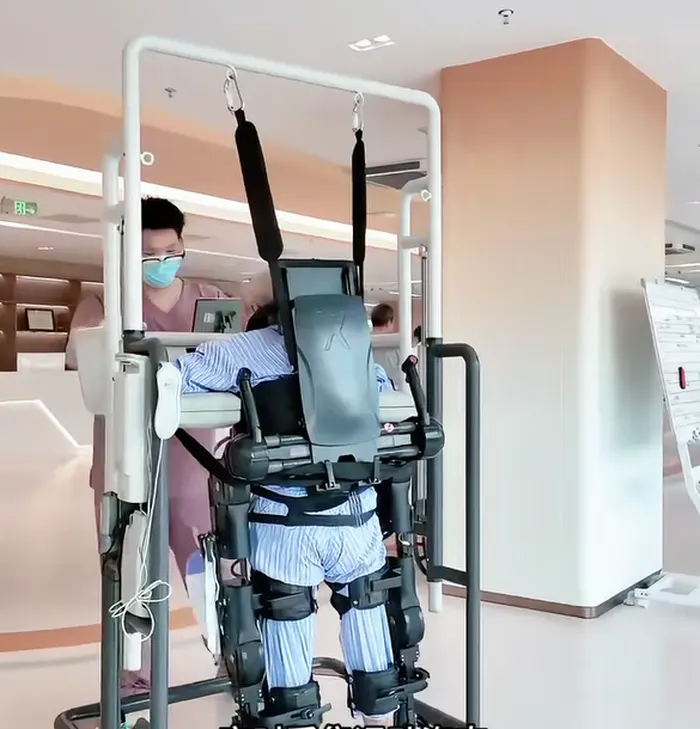
Rehabilitation robotics sells well in photographs — and that is exactly why it deserves an honest explanation before you book a program around it.
What robots are genuinely good at
- Volume with consistency. Recovery depends on a high number of quality repetitions. A robotic trainer can deliver hundreds of smooth, perfectly paced movements per session without fatigue — a servo-driven system responds in milliseconds with jerk-free output.
- Objective measurement. Range of motion and strength are measured by sensors at every session, so progress is tracked with numbers rather than impressions. Our rhythm is assess → train → re-assess.
- Early and safe activation. Body-weight-supported systems (overhead track, ReBorn) let patients practise stepping long before they can safely carry their full weight — which prevents complications and accelerates early mobilization.
- Task-oriented engagement. Scenario-based interaction with visual, auditory and tactile feedback keeps patients engaged, which is half the battle in a 28-day program.
What robots cannot do
- They do not replace clinical judgement. Which mode, which parameters, and when to progress — those are therapist decisions.
- They cannot motivate a patient who has decided to stop trying. Engagement and psychology remain human work.
- They are not automatically better than a skilled therapist for every task. For balance, transfer training and fine hand function, hands-on therapy often remains the core.
How we combine them
In our programs, robots are embedded in a multidisciplinary plan rather than offered as a standalone package. A typical week may combine robotic gait training with TCM treatment, occupational therapy for daily living skills, and speech or swallowing therapy where needed. The robotic array — from the AnkPower ankle trainer and LoopGO Pro four-limb trainer to the dual-column exoskeleton — is the toolkit; the multidisciplinary team decides how to use it.
How to judge a program that offers robotics
- Is there a baseline assessment before training, and re-assessment after each cycle?
- Does the equipment support passive, assistive, active and resistive modes matched to your Brunnstrom stage?
- Is the robot part of a plan, or the whole plan?
- Can the team explain — specifically — which system addresses your limitation?
Ask those four questions of any provider, including us.
Curious which systems fit your case? Send the diagnosis and current mobility level — we will tell you which technology matters and which is marketing noise. Browse the equipment →