
Traditional upper-limb rehab is often “dumbbells, resistance bands, repetitive movements” — boring, time-consuming, and easy to make patients lose the patience to keep going. Yet rehab is exactly the kind of thing that only works through day-by-day accumulation. So the question arises: is there a method that guarantees both scientific rigour and effectiveness, and makes patients willing to persist on their own? That is precisely the problem the upper-limb scenario training system sets out to solve.
What Is the Upper-Limb Scenario Training System?
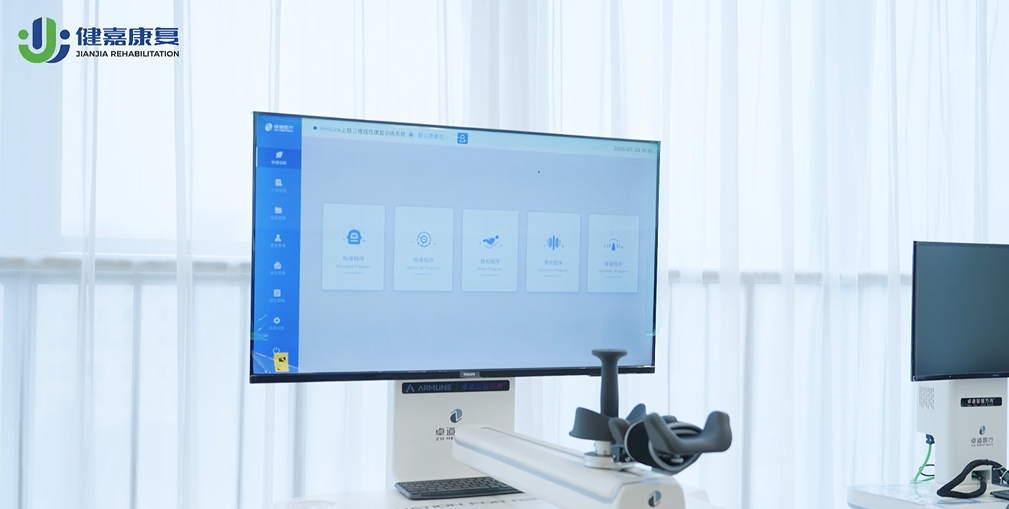
In simple terms, the upper-limb scenario training system is an intelligent training device that combines virtual scenario interaction with rehabilitation medicine movements. Facing an interactive screen, the patient completes a series of “task-based” actions — grasping, pushing and pulling, stretching, rotating — to control game characters or changes in the scene, such as picking fruit, catching balloons, or clearing puzzle levels.
It looks like “playing a game,” but behind every movement lies a carefully designed rehabilitation goal: shoulder range of motion, elbow flexion and extension strength, wrist flexibility, hand-eye coordination — each can be trained specifically through different scenario tasks.

Why Can “Playing Games” Achieve a Rehabilitation Effect?
Behind this lies solid rehabilitation-medicine and neuroscience evidence.
1. Task-oriented training, aligned with the motor relearning principle
Modern rehabilitation widely recognises the concept of “task-oriented training” — letting the patient complete movement training within tasks that approximate real-life scenarios promotes the rebuilding of connections in the brain's motor function areas far better than simply repeating mechanical movements. The grasping and throwing tasks in the scenario system simulate the functional movements of daily life.
2. High-frequency repetition activates neuroplasticity
Whether it is functional recovery after stroke or traumatic brain injury, the core mechanism depends on the brain's “neuroplasticity” — that is, through repeated movement stimulation, new connections are built in the neural pathways around the damaged area. Through gamified level design, the scenario system lets patients complete far more repetitions than traditional training, often without even realising it.
3. Real-time feedback strengthens the training effect
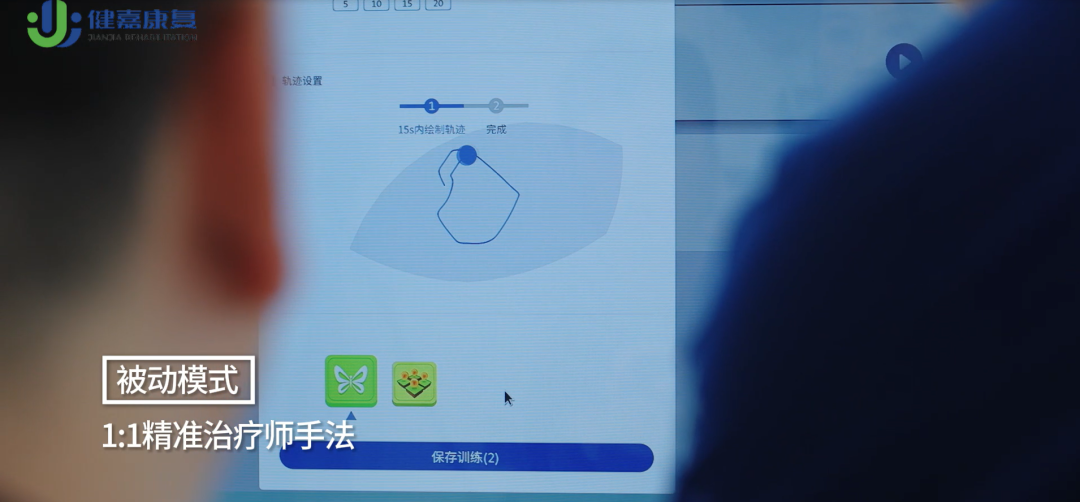
During training the system shows completion in real time — speed, amplitude and accuracy are all displayed intuitively on the screen. This “biofeedback” mechanism helps the patient adjust how they exert force in time, and lets the therapist grasp the patient's rehab progress more precisely and adjust the plan dynamically.
4. It improves training adherence
Rehab outcomes depend to a large extent on whether the patient can persist actively over the long term. Boring repetitive training often makes patients resistant, whereas scenario-based, gamified training significantly raises participation and a sense of achievement — shifting from “I have to train” to “I want to train.”
Who Is It Suitable For?
The upper-limb scenario training system is mainly used for rehabilitation in the following situations:
- Upper-limb motor dysfunction left after stroke (cerebral apoplexy)
- Limb function recovery after craniocerebral (brain) trauma
- Functional exercise after orthopedic surgery (e.g. shoulder, elbow or wrist joint post-operation)
- Hand dysfunction caused by peripheral nerve injury
- Functional maintenance training for the elderly with declining muscle strength and reduced coordination
One reminder: the scenario training system is an important part of rehabilitation treatment, but the specific training plan still needs to be set by a rehabilitation physician and therapist based on the patient's assessment — do not judge the training intensity or content on your own.
Rehab is never an easy thing, but it can be made less boring. JianJia Rehabilitation hopes that when technology meets rehabilitation medicine, training is no longer just a burden of repetition, but a “level-clearing game” with feedback, progress and achievement.
This is also an important future direction for rehabilitation medicine: to help every patient return to normal life faster and better, through more scientific and more humane methods.


Individuals differ. This article is for health education only and is not a substitute for medical advice. If you feel unwell, please visit a hospital. Some images are sourced from the internet; if there is any infringement, please contact JianJia Rehabilitation to remove them.