Long-term high blood glucose in diabetes slowly damages the vascular lining, promotes platelet aggregation and thrombosis, and compromises circulation throughout the body. The feet are hit hardest — they are the furthest point from the heart, and once their blood supply fails, recovery is the most difficult.
Of every five patients who come to hospital with a diabetic foot, roughly one will eventually lose part of a limb. In China, the population living with diabetic foot and peripheral arterial disease is estimated at over 50 million, and around 3 to 3.5 million new diabetic-foot ulcers appear each year.
Traditional vascular surgery can reopen the body's "main roads" — the large vessels — but has few options for the blocked "side roads" of the microcirculation. That gap is where many patients end up facing amputation.
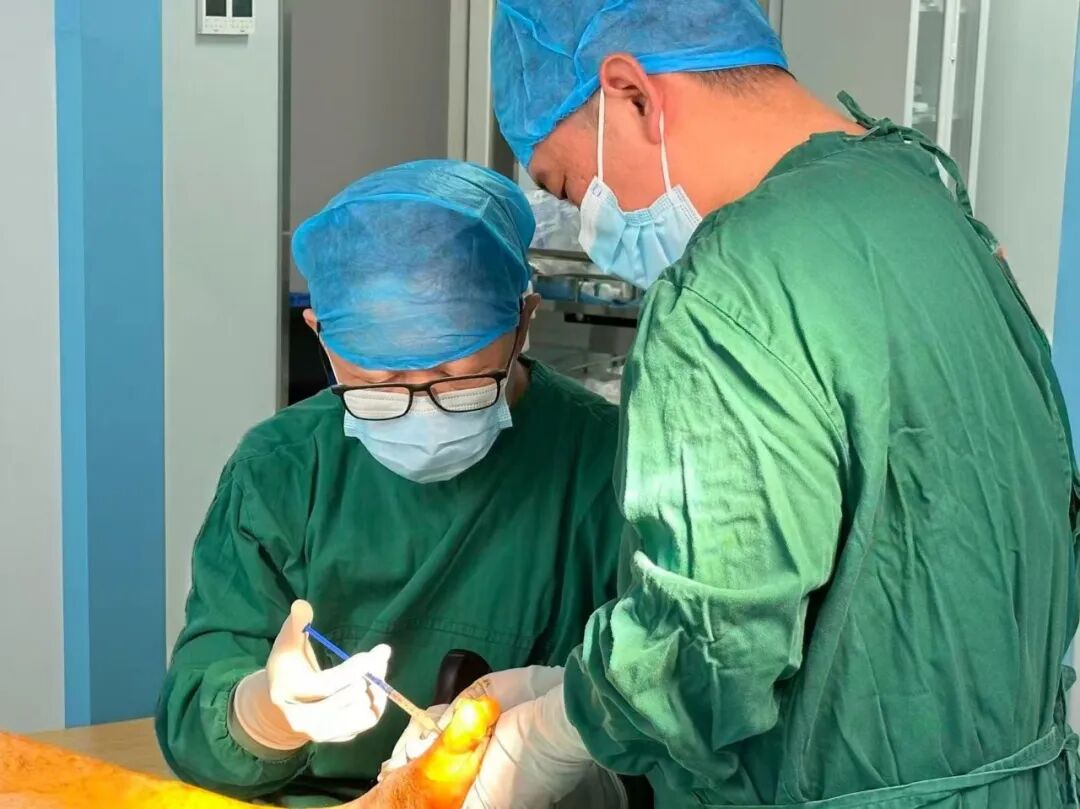
Professor Bi Sheng, Chief Rehabilitation Specialist of JianJia Medical and one of the earliest scholars in China to advocate "regenerative rehabilitation," leads a team that developed an "autologous blood cell + PRP implantation" technique for rebuilding lower-limb microcirculation. In a recent conversation, we asked him a simple question: when the main road is open but the side road is not, can regenerative rehabilitation become the "golden key" that rewrites the amputation outcome for diabetic foot?
When the main road is open but the side road is not
"Endovascular treatments in traditional vascular surgery — balloon dilation, stenting and the like — do open the large vessels. We call those the main roads," Professor Bi explains. "But the instruments cannot reach the small arteries of the microcirculation. The main road is open, but the side road is not, so the wound still has no blood supply and of course it will not heal."
The 10th edition of the IDF Diabetes Atlas projects that by 2030, China's population aged 20–79 living with diabetes will reach about 164 million. Diabetic foot is among the most serious complications, and as the base of patients grows, so do their numbers. A domestic multicenter survey found that among diabetes patients over 50, the annual incidence of diabetic-foot ulcers reaches 8.1%, while among diabetic-foot patients the amputation rate reaches 19.3%.
Regenerative rehabilitation builds a new network
Regenerative rehabilitation takes a different technical route, based on a rethinking of the treatment target: the original vessels are severely calcified and occluded, so instead of betting everything on repeated unblocking, it "creates something from nothing" in the ischemic tissue — rebuilding a blood-supply network.
"The essence of our technique is to build a side road where there was none," Professor Bi says. "Just as a city has small branches and alleys alongside its main arteries, we re-establish the blocked microcirculation so blood can reach the wound and the nerve endings."
The "side road" is built by borrowing from overseas PRP (platelet-rich plasma) thinking and making one key improvement: combining the patient's own blood cells with PRP and implanting them together, forming a new path of "in-situ vascular regeneration."
"In-situ vascular regeneration does not depend on the original vessels growing outward; it creates something from nothing. It is like planting seeds into the muscle and fascia, and the vessels grow by themselves, connecting with the main vessels to supply the tissue."
Why only the patient's own blood?
Professor Bi compared this approach with two alternative routes. One extracts 200–400 ml of bone marrow, separates and concentrates it, then implants it — large trauma, high cost, and "many patients will not accept it." The other uses a mobilizer to push immature cells from the bone marrow into the blood, requiring 4–5 consecutive days of injections; the cost is also high, with possible side effects such as bone pain or even cerebral infarction.
"Our technique uses neither bone-marrow cells nor a mobilizer. We separate the cells directly from the blood, add PRP, and jointly implant them into the patient's ischemic lower limb. It is entirely autologous, so there is no rejection problem, and it achieves the same, very good result."
Two patients who walked again
Mr. Fu, 62 — severe diabetic foot
His left foot was painful, with an ulcerated, infected wound that would not heal. Two toes had already been amputated. Angiography showed multi-segment occlusion and severe stenosis of the left anterior tibial artery, and multiple treatments had failed. After two sessions of the therapy — "repairing the side road" — Mr. Fu's wound healed completely, the lower-limb pain disappeared, and he could walk, drive, and return fully to normal life.
Mr. Fang, 37 — thromboangiitis obliterans
Over two years he had undergone three lower-limb vascular interventions and one toe amputation. His left great toe still had a skin defect with exposed bone, and he could walk fewer than 140 steps before calf pain forced him to stop. CT angiography showed the left superficial femoral artery was completely occluded from its mid-section to the end of the popliteal artery — traditional methods were powerless against the microcirculation. After two "autologous blood cell + PRP" regenerative treatments in February and April 2026, follow-up showed his painless walking distance improved from under 150 meters to about an hour of walking.
"The intervention opened the main road, but the microcirculation side roads were still blocked," Professor Bi says. "We created a blood-supply network from nothing in the ischemic tissue, giving patients who had no road a new road to life."
The technique needs specific equipment; ordinary simple PRP separation cannot reach this level. Implantation is performed under ultrasound guidance, and the whole process of cell separation plus implantation takes about 4–5 hours.
A rehabilitation doctor's path to regenerative rehab
Professor Bi Sheng is one of the few scholars who spans both "rehabilitation medicine" and "regenerative medicine." Before becoming Chief Rehabilitation Specialist of JianJia Medical, he long served as director of a rehabilitation medicine center at a leading domestic medical institution.
The idea of regenerative rehabilitation did not appear from nowhere. Around 2010, overseas scholars began calling for deep integration of regenerative and rehabilitation medicine; in 2014, Columbia University in the United States became the first to bring regenerative rehab into a rehabilitation academic department, establishing the first joint rehabilitation-and-regenerative-medicine unit led by Dr. Joel Stein. In China, Professor Bi is among the earliest to promote this cross-disciplinary fusion, and in 2024 he argued that "regenerative rehabilitation is the future of rehabilitation medicine."
"These two disciplines face the same kind of diseases — the ones that cannot be cured. Their methods are stackable; physical therapy can raise the efficiency of regeneration." In his view, rehabilitation medicine exists precisely for those "incurable diseases," while regenerative medicine has a chance to reverse the pathological process — which is why he defines regenerative rehabilitation as the future of the field.
At Wuhan JianJia Rehabilitation Hospital he has been sorting out the existing traditional rehabilitation system while letting regenerative rehabilitation take root within it. "The first time was probably around 2018, and we kept going through the pandemic." From early exploration to clinical implementation at Wuhan JianJia, this path has taken Professor Bi nearly six years, during which he continually refined the technical route until it became the current "autologous blood cell + PRP" combined protocol.
Not competing with vascular surgery — complementary
In Professor Bi's view, a rehabilitation department working on diabetic foot is not "grabbing territory." Classic overseas rehabilitation textbooks already contain a chapter on "vascular rehabilitation" — promoting collateral circulation through exercise, which belongs to physical therapy. What he wants to do is stack biological technology on top of that foundation. In his words, the effect is "geometric."
A rehabilitation department has its own strengths: ultrasound-guided precise injection, long-term follow-up management, and comprehensive pain control. And the most important point — "after saving the limb, we also need to let the patient walk and live."
"So we are not in competition with vascular surgery, but complementary — you build a highway, and I build a side road; when the highway is jammed, the side road can still reach the airport."
The earlier the intervention, the better
Professor Bi is especially keen to correct one misconception: many people think diabetic foot only needs treatment once a wound appears. "The early sign of diabetic foot is often not the wound, but peripheral neuropathy — the patient feels numbness, coldness and dull sensation in the foot. Many do not realise that the essence of these symptoms is also ischemia. So under ultrasound guidance we can intervene already at the neuropathy stage, improving the nerve's blood supply and reversing the course before a wound forms."
This is also where regenerative rehabilitation differs from the traditional mindset: do not wait for the wound to appear before treating — the earlier the intervention, the better.
Professor Bi stresses, however, that the "in-situ vascular regeneration" technique is not suitable for everyone. "One group of patients responds less well — those with long-segment occlusion above the knee artery. Apart from that, most situations respond very well. Patients in poor general condition or of advanced age also need careful assessment."
Landed, and the cost question
The technique is now implemented at Wuhan JianJia Rehabilitation Hospital, which has one of the few wound-rehabilitation wards in China and the basic conditions for the technique to take root.
"In the short term the cost may be somewhat higher, but in the long run the hospital stay will undoubtedly shorten. What used to need two months of admission may be cured in a few days, so overall it still saves cost — and the patient's limb-preservation success rate is far greater than with traditional protocols."
Professor Bi hopes that the application of regenerative medicine in rehabilitation can move a little faster.
This article was prepared from the interview for general health education. It does not replace individual medical advice. Any treatment or training plan should be set by qualified clinicians after assessment.