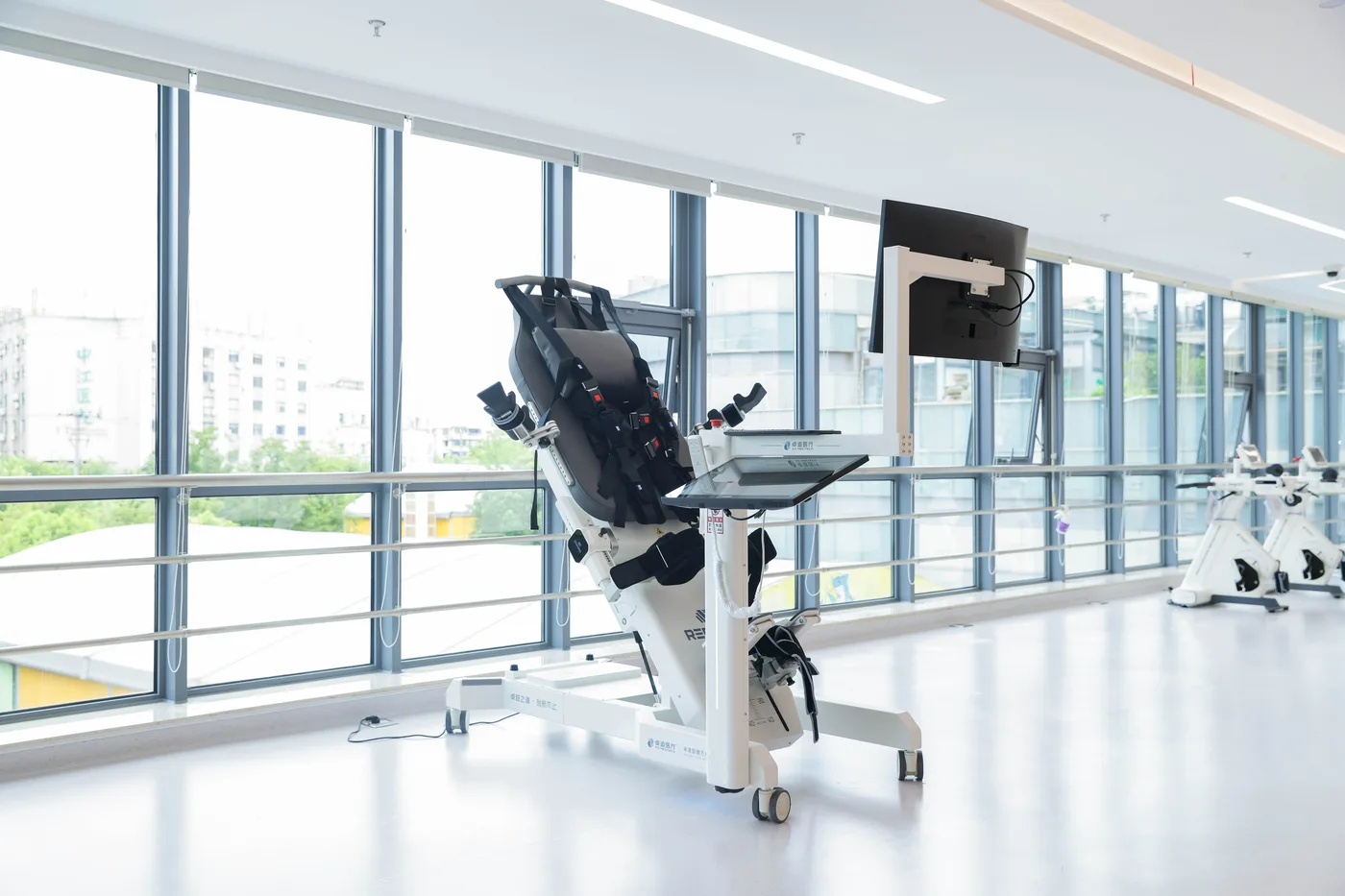
Many families walk into a rehabilitation department for the first time and see the patient lying on a training bed whose tilt angle can be adjusted, both feet fixed to footplates, and a screen in front showing nothing but curves and numbers. Their first reaction is usually: isn't this just moving about in bed? Couldn't we do more of this at home? The therapist's answer is normally: no — and the difference is considerable.
This article skips the complicated terminology and covers just three things: what lower-limb feedback training actually is, why it is more effective than forcing yourself to walk, and how patients and families should judge it and work with it.
First Things First: Is It Training the Legs, or the Brain?
In plain language: lower-limb feedback training uses equipment to turn “invisible” body signals — how hard a muscle is firing, joint angles, pressure distribution under the foot, whether the left and right gait phases are symmetrical — into prompts you can see, hear and feel in real time, so that the patient can adjust the movement accordingly and re-learn how to walk.
It is not a massage machine, not a gym stepper, and not merely an electrical stimulation device. It does not replace the therapist, and it certainly does not mean “the more walking, the better”.
What it actually acts on is the motor chain of brain, nerve and muscle. It is particularly suited to people who know how they ought to walk, but whose nerve signals do not get through and whose muscles will not obey. For these patients the problem is often not in the legs at all, but in the brain's capacity to command movement and correct errors.
So remember the first sentence: what lower-limb feedback training trains is the brain's ability to command the legs to walk again.
Why Can “Visible Feedback” Help Someone Walk Again?
Start from one premise: the brain is plastic. After an injury, function is not fixed for good; through repeated, correct training the brain can rebuild and strengthen neural connections.
Re-learning to walk is, in essence, motor re-learning. It depends on a loop: make a movement, see the result, notice the error, adjust, make the movement again. Healthy people complete this loop automatically through proprioception and vision — when they stray, they correct immediately.
After a neurological injury, this “internal feedback” is impaired. Whether the muscle is firing, whether the leg is lifted high enough, whether the centre of gravity has shifted — the patient cannot feel it. So the faulty gait pattern is repeated over and over, and becomes more and more “familiar”.
What lower-limb feedback training does is restore that missing feedback. The curves on the screen, the cue tones, the lights, and in some cases paired electrical stimulation, all tell the brain “that step was right” or “that step was wrong”.
Think of the instructor in the passenger seat while you were learning to drive: cross the line and you are warned at once; straighten up and you are praised at once. Practise enough, and the ability to correct yourself is internalised from an external prompt into your own judgement.
The mechanism has evidence behind it. China's guidelines for the clinical management of cerebrovascular disease state that functional electrical stimulation and electromyographic biofeedback therapy, combined with conventional rehabilitation, can improve the muscle strength and function of a paralysed limb (Class I recommendation, Level B evidence).[1]
So How Does It Actually Help You Walk?
Several forms of lower-limb feedback equipment are used clinically. The tilt-table type is the most common: an angle-adjustable training bed, the patient lying on it with both feet fixed to footplates, and a screen in front displaying the training data.
Step 1: set the tilt angle
The therapist sets the bed to the appropriate angle according to the patient's muscle strength and endurance, anywhere from close to lying flat to close to standing. The lower the angle, the less load the lower limbs bear, which suits patients with early weakness; the higher the angle, the closer the body comes to the weight-bearing state of real standing and walking.
Step 2: drive the lower-limb gait
The device moves both feet through alternating stepping along a curve close to that of normal human walking, so that the body re-experiences what “the right way to walk” feels like. Training can be fully machine-driven (passive mode), or driven by the patient's own effort with machine assistance (active mode).
Step 3: display and feed back in real time
During training the screen shows gait data, force waveforms and training status in real time. Many devices include virtual scenes to make the session more engaging, and voice prompts announce the current status as it happens.
Step 4: protect and correct
Most of these devices include spasm detection: as soon as spasm in the lower limbs is detected, the drive stops immediately to prevent injury. Training mode and intensity are set individually by the therapist according to the assessment results.
There is one key point that is easily overlooked: bed angle, cadence, session length and training mode are all set individually by the therapist on the basis of the assessment. It is not a case of “the stronger the parameters, the better” — what works best is “just enough, with a slight challenge”.
Who Is It Suitable For? And Who Is It Not?
Lower-limb feedback training is not for everyone; a rehabilitation physician must carry out an assessment first. According to the expert consensus on the clinical application of lower-limb rehabilitation robots, the main candidates are:[2]
- Neurological conditions: lower-limb dysfunction caused by stroke, traumatic brain injury, spinal cord injury, paediatric cerebral palsy, Parkinson's disease and similar conditions.
- Musculoskeletal conditions: patients who need to restore walking function after internal fixation of a lower-limb fracture, or after joint replacement.
- Others: patients who have been bedridden for a long time, whose walking function is markedly impaired, or who need early intervention.
The following situations usually require careful assessment or should be postponed: severe cardiopulmonary insufficiency; an unhealed fracture or unstable internal fixation; broken or infected skin on the lower limbs; the acute phase of deep vein thrombosis; and severe cognitive impairment that prevents cooperation with training.
Note: whether training can be done, when it should start and at what intensity are all decided by the rehabilitation physician and therapist after assessment. It is not a matter of “if you want it, you can have it”, and still less of “the earlier and the stronger, the better”.
The Four Misconceptions Families Most Often Fall For
Misconception 1: “Training is just walking — walking more at home will do.”
Blindly walking more at home is very likely to reinforce a faulty gait — circumduction, dragging the foot, deviating the centre of gravity. The more practised the faulty pattern becomes, the harder it is to change. The whole point of the equipment is to let the patient repeat the movement within a pattern that is close to correct.
Misconception 2: “The more it hurts, the more effective it is.”
Rehabilitation training produces fatigue, but it should not produce severe pain. If marked pain or dizziness appears during a session, tell the therapist immediately — do not grit your teeth and carry on.
Misconception 3: “Once you're on the machine, you'll walk.”
The equipment is a training tool, not a vehicle. Results depend on active participation, training intensity and frequency. If the patient is simply being “carried along by the machine”, the benefit drops sharply.
Misconception 4: “Leave treatment to the therapist — the family doesn't need to be involved.”
The home environment and family support determine whether rehabilitation continues. But how to help, and how much to add, must follow the therapist's guidance — do not add extra practice at home on your own initiative.
A simple criterion for judging: good training means “the patient participates actively, the intensity progresses gradually, the goals are specific and measurable, and the programme is reassessed regularly” — not “lie down and wait for the machine to turn”.
A Tool on the Journey, Not Magic
Lower-limb feedback training is one tool on the road to recovery, not a magic wand.
The conditions for it to work are plain: accurate assessment, an individualised plan, active participation by the patient, and timely adjustment by the therapist. For families, the most useful thing is not to worry about “when will they be able to walk”, but to cooperate with the assessment, understand the goals, record the changes and give feedback in good time.
Walking is trained — but it has to be trained along the right path. When it comes to accompanying a family member through rehabilitation, going a little slower and a little steadier often turns out to be faster.
This article is for general health education only and does not replace individualised medical advice. Actual training must be assessed and carried out under the guidance of a qualified professional.
References
[1] Guidelines for the Clinical Management of Cerebrovascular Disease in China (excerpt) — Stroke Rehabilitation Management: functional electrical stimulation applied to the relevant muscles, and electromyographic biofeedback therapy, combined with conventional rehabilitation, can improve the muscle strength and function of a paralysed limb (Class I recommendation, Level B evidence). Source: Chinese Stroke Association, Chinese Journal of Stroke.
[2] Expert Consensus on the Clinical Application of Lower-Limb Rehabilitation Robots (2023): indications cover neurological conditions such as stroke, paediatric cerebral palsy, traumatic brain injury, spinal cord injury and Parkinson's disease, as well as musculoskeletal conditions such as the period after internal fixation of a lower-limb fracture. Source: Chinese Medical Journal / expert consensus publication platform.
[3] Target gait-parameter biofeedback training improves gait in subacute stroke patients: a single-blind randomised controlled trial (PMC11598387).
[4] Effects of haptic feedback interventions on gait and balance impairment after stroke: a systematic review and meta-analysis (PMC11433178).
[5] Korean clinical practice guidelines for stroke rehabilitation (2022): functional electrical stimulation is recommended to improve motor function in stroke patients (high level of evidence) (PMC10404807).
Individuals differ. The content of this article is for general health education reference only; if you feel unwell, please attend a hospital. Some images originate from the internet; if there is any infringement, please contact JianJia Rehabilitation for removal.
Explore the ReBorn lower-limb feedback training system used in our programmes, or read more about robot-assisted rehabilitation.